
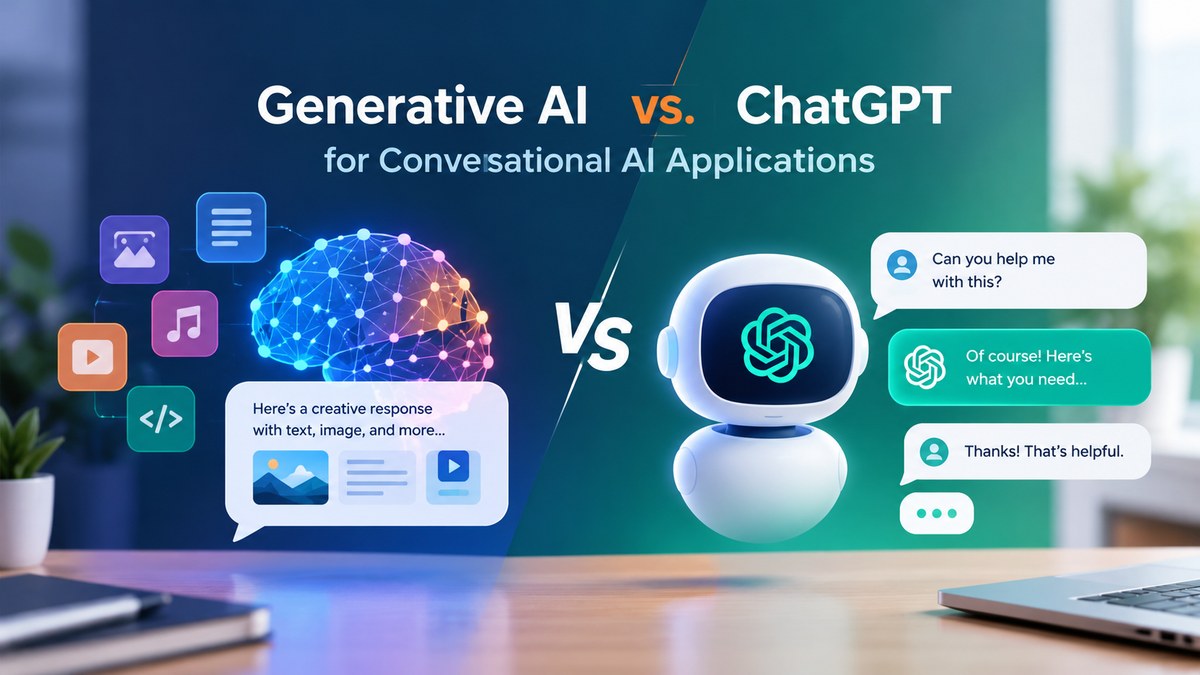
Teams planning a chat product often use two terms as if they mean the same thing. They do not. Generative AI is a broad category of technology, while ChatGPT is one specific product built on top of it. Mixing them up leads to weak architecture decisions, surprise costs and launches that stall after the demo.
This guide explores generative AI vs ChatGPT in practical terms. You will learn about the scope of each term, a comparison of the two concepts, application in different conversational AI areas, and when to choose ChatGPT versus building something on your own.
What Is Generative AI?
Generative AI refers to models that create new content, like images, text, audio, code, and video, based on patterns learned from large datasets. In conversational products, the most relevant branch is large language models (LLMs). These foundation models are trained on huge volumes of text and handle natural language processing (NLP) tasks like summarizing, translating, answering questions and holding a dialogue.
What really matters is that generative AI is a capability and not a tool. There are several ways of accessing it through hosted APIs, self-hosted open-source models, and adapted models using your data set. All these options affect the degree of control over the behavior and data management and cost.
Businesses that want this capability inside their own products usually work with a partner offering generative AI development services. That work covers model selection, prompt design, retrieval pipelines, evaluation and deployment, rather than just placing a chatbot widget on a page.
Because the category is so wide, comparing it with a single product only makes sense when you are clear about what sits on each side. That clarity is the core of the generative AI vs ChatGPT discussion.
What Is ChatGPT and Where Does It Fit?
ChatGPT is a conversational product from OpenAI built on its GPT family of language models. It gives anyone a ready interface for drafting, brainstorming, analysis and question answering, with no engineering work required. Developers can also reach the underlying models through an API and place them inside their own apps.
ChatGPT is ideal in scenarios where speed is prioritized over customization. The lead of the support can experiment with response templates in a day or two. The product development team can experiment with building a virtual assistant without having to invest budget yet. Even prompt engineering alone can yield surprising results.
The limitations come later. A general purpose tool is unaware of the pricing policies, internal documentation, and even customer history unless you provide the context to it. The assistant also operates on infrastructure which you do not have control over, hence giving rise to issues of data privacy. The OpenAI documentations on enterprise privacy provides an insight into how OpenAI treats business data, and must be studied by teams working with sensitive information.
Pricing is usually per seat or per token, which keeps early costs predictable. So the generative AI vs ChatGPT difference comes down to a broad toolkit versus one packaged option from that toolkit.
Generative AI vs ChatGPT: Key Differences
The table below shows generative AI vs ChatGPT across the factors that matter most for conversational AI applications.
| Factor | ChatGPT (used directly) | Custom generative AI solution |
| Scope | One packaged assistant and API | Any model, architecture and workflow you choose |
| Customization | Prompts and limited settings | Fine-tuning, RAG, custom logic and brand tone |
| Data control and privacy | Depends on vendor plan and terms | Full control over storage, access and logging |
| Integration flexibility | API connections and plugins | Deep API integration with CRMs, ERPs and databases |
| Scalability | Bound by vendor limits and pricing tiers | Scales with your own architecture and model choices |
| Cost model | Subscription or per-token usage | Higher upfront build, lower unit cost at high volume |
| Best-fit use cases | Prototypes, internal drafting, low-risk Q&A | Customer-facing, regulated or domain-specific products |
Neither column wins in every case. The right answer in the generative AI vs ChatGPT decision depends on risk, volume and how much domain knowledge your assistant needs.
Where Conversational AI Applications Use Each Approach
Different conversational AI applications place different demands on accuracy, privacy and tone. Teams that need a production-grade assistant often start with AI chatbot development services to match the right model and architecture to each use case. Here is how the generative AI vs ChatGPT choice usually plays out in practice.
Customer support automation. ChatGPT performs excellently in writing responses that are then reviewed by the human representative. The chatbot for a customer that is supposed to quote the company’s policies regarding refunds and warranties should have additional capabilities of being an enterprise-level AI chatbot based on the ticket history and help center, as well as having the option to contact a human.
Sales assistants. General-purpose assistants can draft the correspondence. Custom assistants can access your inventory data and CRM notes, as well as lead qualifying according to your own criteria.
Internal knowledge bots. Employees ask about HR policies, engineering runbooks and product specs. Answers must come from approved documents, so retrieval from your own content matters more than the raw power of the model.
Voice AI and omnichannel chatbot experiences. Voice assistants add speech recognition, low latency and interruption handling. An omnichannel chatbot must keep context across web chat, mobile apps and messaging platforms. Both need engineering work that a standalone chat window does not provide.
Healthcare and fintech. The clinic can implement a chatbot for appointment scheduling and pre-appointment inquiries, but there are strict limitations to the information the chatbot can divulge about the treatment choices. The Fintech application can provide a chatbot that will help to analyze transactions and card disputes, including audit trails and identity verification.
Across all of these examples, the generative AI vs ChatGPT choice follows one rule: the higher the cost of a wrong answer, the more control you need over data, tone and behavior.
When ChatGPT Is Enough and When You Need Custom Generative AI
In a generative AI vs ChatGPT comparison, the direct ChatGPT route is enough when the stakes are low, and the content is general. For instance, where the risk of a wrong response is low and the records are not sensitive, activities such as early drafting, prototype creation, brainstorming of conversations, and responding to generic inquiries can be done directly.
Various companies combine both paths. The ChatGPT vs custom LLM journey often begins with a quick prototype and moves to a dedicated stack once usage grows. At that point, generative AI integration services can connect models to your existing CRM, ticketing, and database systems, so AI integration adds to your current tools instead of replacing them.
Custom generative AI becomes the better choice when accuracy, control or scale start to matter. Four areas usually trigger the switch:
- RAG (retrieval-augmented generation). RAG fetches relevant passages from your own documents and gives them to the model before it answers. The method was introduced in a widely cited research paper on retrieval-augmented generation and is now a standard way to reduce made-up answers.
- Fine-tuning. Model training on the basis of your conversations helps the model learn your tone, vocabulary, and edge cases. It works best when you have a stable, repetitive task that has become brittle through prompt engineering.
- Security. Custom builds let you decide where data is stored, who can read logs and how prompts are filtered, which matters for any enterprise AI chatbot.
- Compliance. Regulated teams need audit trails, access controls and documented model behavior. These are easier to design into your own stack.
These four areas are where the generative AI vs ChatGPT gap is widest.
How to Choose the Right Approach for Your Conversational AI Project
A clear decision process saves weeks of rework. Teams that want a working product rather than a demo often bring in AI application development services at this stage to validate the plan. Before you do, work through this generative AI vs ChatGPT checklist:
- Is the data used sensitive or regulated?
- Should the responses only come from your own documents and be consistent?
- Do you require any integrations with CRMs, payments, or internal databases?
- Will the number of conversations be high enough that per-message pricing becomes expensive?
- Do you need context awareness and intent detection for your particular use case?
- What could be the acceptable level of mistakes before the user loses trust?
- Do you have internal capabilities for prompt engineering, evaluation, and monitoring?
In case the majority of responses is “yes”, go for the customized approach. Otherwise, begin with ChatGPT and re-evaluate the decision once you have actual usage statistics. In any case, conduct a pilot program using actual queries of your users to measure the resolution rate, the accuracy of answers, the rate of escalation, and customer satisfaction, thus making the decision based on the numbers. When comparing generative AI and ChatGPT, your own traffic speaks volumes.
Conclusion
Generative AI is the wider field, and ChatGPT is one way to use it. The generative AI vs ChatGPT choice is not about which is smarter. It is about how much control, accuracy and integration your conversational AI applications need. Start simple when the risk is low, and invest in custom AI solutions when your product depends on trusted answers and secure data.
If you are ready to scope a build, you can hire AI developers from CMARIX who can design, test and launch the right assistant for your business.



Leave feedback about this